
From Fr. Mark-April 26,2026
- markstec6
- Apr 24
- 6 min read
FOURTH SUNDAY OF EASTER-
‘Preach the truth as if you had a million voices. It is silence that kills the world.’- St. Catherine of Siena, Virgin and Doctor of the Church
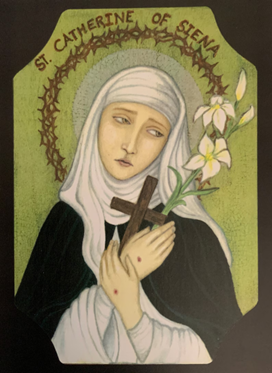
This Wednesday, April 29, the Church remembers St. Catherine of Siena. Throughout St. Catherine of Siena’s life, the actions and lifestyles of many in the Church did not match up with the Church’s faith. Stagnation reigned over religious praxis in Europe. Ecclesial ministers — not excluding popes — were marked by corruption and evil lives, while society exhibited growing depravity. Many thought the Black Death was God’s solution to the moral rot that plagued society, but no solution is more effective for cultural reform than holiness. And St. Catherine, born at the same time that nearly a third of Europe was dying, had holiness to a great degree.
Most of Catherine’s life was concealed in obscurity. She was one of of 25 children born to Giacomo di Benincasa, a wool dyer, and his wife, Lapa. From an early age, Catherine (1347-1380) wanted to dedicate her life to Christ alone, and she often secluded herself from family and community. As a young woman, her family attempted to lure her toward another path in marriage to her late sister’s husband. In her teens, she took on the white and black habit of the Sisters of Penance of St. Dominic.
It appears that Catherine would have been content to remain in the family home, living as a recluse with intense fasting and penances. Her ascetic and penitential life was borne from a desire to conform with Christ crucified, which meant it was lived for others.
Catherine received mystical visions and supernatural experiences. Representative of her union with Jesus, she bore the wounds of his passion and death, known as the stigmata. Despite being invisible to those around her, these marks caused her great agony.
The Lord wanted her to leave behind her hidden life, and Catherine entered a new public era of life directed toward extensive service to the poor and vulnerable. Even more, she illuminated a dark world by her holiness.
On account of her reputation, many sought the counsel of Catherine, and sometimes she spoke out on her own initiative. The fearless, uneducated woman was unafraid to speak truth to even the most powerful men of her time.
Lamenting the morally deficient clergy, Catherine remarked that “many layfolk put them to shame by their good holy lives.” She relentlessly called out various leaders, including popes, for their failures, challenging them to work once again for the good of the Church and the salvation of souls.
Catherine knew any real and lasting reforms needed the support of the popes, and she possessed the insight that popes would be effective in governance if they returned to Rome from Avignon, France — where the papacy had relocated and which many regarded as scandalous. She confronted Pope Gregory XI, who subsequently returned to Rome. When he died in 1378, however, the Church plunged further into turmoil with the election of Pope Urban VI. When his election was opposed by a powerful faction that elected their own candidate as an antipope, the Western Schism began.
It might have seemed like Catherine’s earthly efforts were stacking up against her, not amounting to much. She knew that if all her attempts at persuasion bore little fruit, she must reorient her energy to sacrifice herself to God on behalf of the Church. Her final days were spent wrestling with demonic voices that tempted her to see all her work as nothing but a failure — even as the product of her own will rather than the Lord’s. At only 33 — traditionally regarded of Christ’s age at his death — St. Catherine died in Rome on April 29, 1380.
In his General Audience of November 24, 2010, Pope Benedict XVI reflected on the life, the teachings, and the impact Saint Catherine had—not only upon Italy, but upon us all.
Here are five lessons we can take away from the life of Saint Catherine:
Saints give us a “jolt.” In his reflections, Pope Benedict said, “Even in the most difficult times, the Lord does not cease to bless His People, bringing forth Saints who give a jolt to minds and hearts, provoking conversion and renewal. This jolt ‘impels us to walk courageously toward holiness, to be ever more fully disciples of the Lord.’”
People followed Catherine wherever she went, sensing that she was very special. Sinners came to her as well, and in fact several priests often followed her around to hear the confessions of all those who listened to Catherine speak of God’s love for them and urge them to repent.
Saints are rooted in the basics. Pope Benedict said of Saint Catherine that she “dedicated herself to prayer, penance, and works of charity.”
For the saints, greatness is rooted in the Works of Mercy. In Matthew 5:16, Jesus says, “Just so, your light must shine before others, that they may see your good deeds and glorify your heavenly Father.”
People were drawn to Catherine because of the prayerful, humble, loving, and sacrificial way in which she conducted herself on a daily basis. As she was dying, Catherine confessed that she felt as if she had failed in her mission to bring about world peace — but she had certainly not failed at the most important thing, which is loving God and carrying out His desires.
We are not asked to be the smartest, the strongest, the fastest, the wealthiest, or the most popular. Instead, we are asked to be loving, compassionate, faithful, and trusting in our Lord.
Saints embrace suffering. Catherine begged our Lord that she might suffer for those people who would not say prayers or do penance for their sins. And the Lord allowed it.
In fact, He even pierced her hands, feet, and side in the same way Jesus’ wounds were inflicted during his passion. Nobody except Catherine could see these wounds — yet, she carried them for the rest of her life.
Often, our own suffering is not visible on the outside; those around us are unaware of our anguish. Like Catherine, we are called to offer our suffering to God, for the conversion of sinners and the salvation of souls.
Saints don’t have to be brilliant or prolific. As a child, Catherine learned to read only with great difficulty, and she didn’t learn to write until she was an adult.
Her body of writing is quite small, consisting only of her Dialogue, a collection of Letters, and a small handful of prayers.
As a child of six, Catherine’s only wish was to become a hermit; to live alone in a cave so that she might think of the Lord always without distraction. (Thankfully, the Lord convinced her to return home to become His servant among her own family members and in her little community.)
She did not dream of wealth, fame, intelligence, or beauty. All she wanted to do in life was love and serve the Lord.
Saints are totally focused on God’s love. Pope Benedict XVI reminds us, “Like [St. Catherine], every believer feels the need to be conformed with the sentiments of the heart of Christ to love God and his Neighbor as Christ himself loves.”
When we love like Jesus loves, we accept, forgive, withhold judgement, offer support, and give hope.
Matthew 25:38-40 says, “Then the righteous will answer him and say, ‘Lord, when did we see you hungry and feed you, or thirsty and give you drink? When did we see you a stranger and welcome you, or naked and clothe you? When did we see you ill or in prison, and visit you?’ And the king will say to them in reply, ‘Amen, I say to you, whatever you did for one of these least brothers of mine, you did for me.'"
Catherine focused her whole heart upon serving those in her family, her community, and eventually, her country.
Like most saints, Catherine of Siena wasn’t striving for greatness; she was simply trying to live a life that would honor our heavenly Father. Let us pray to Saint Catherine that we might follow in her footsteps, humbling ourselves and focusing on how we can best serve our family, our community, and our Lord.


Comments